

Black or African | Humans are not Crayons
 Blackness Started in Slavery to justify the enslavement of people from Africa1 Race was invented by Whites between the 16th century and the 18th century and it wasn’t a conspiracy because every inch of the construction and their motives for doing so is on record. Hume, Kant, Chamberlain, Gobineau, Nott, Agassiz, Nott wrote to Morton explaining “My niggerology, so far from harming me at home, has made me a greater man than I ever expected to be.” Seminal books like “Types of Mankind” (1854) were bestsellers and finally influenced racist antisemites like Wagner and Hitler. We could now safely argue that the Enlightenment of Europe was the creation of racism and race.
“We are not African because we are born in Africa, but because Africa is born in us” Chester Higgins.
Please also see the article on African Race which has overlapping and extended info

Buy Now
We have to start this discussion in its most basic terms. Where do Black people originate from? Then if the answer is Africa, then what is the purpose of identifying with a color over our beautiful Motherland? We could end all discussions with just that simple sentence. When Europeans were trying to sell their color identities to Indians, Chinese, and Native Americans we were the only ones who bought this color-based identity and invested everything in it. The Indians never once traded being Indian/Asian for brown. The Chinese did not trade being Asian for yellow–not even for 1 second. They do not have Yellow History Month and Yellow Lives Matter.
“race” is now. It is not historical and what we call “race” now will change in the future and will always mean different things to different people. 2
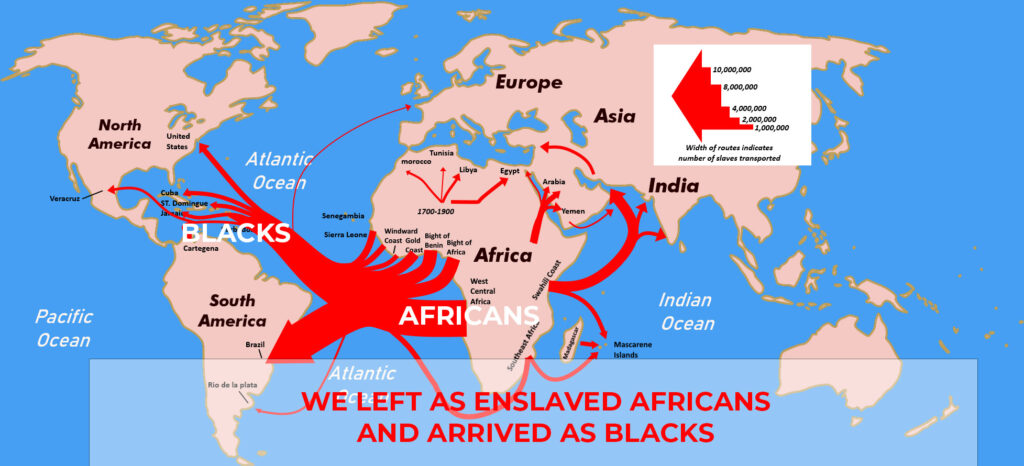
The problem can be categorized into different categories; one is laziness and habit. It is much easier to say Black than to articulate a more nuanced identity. But that has never been a burden on Arab Americans, Asian Americans, or any other group. It is not seen as critical, so even people who 100% agree with our position default back into speaking about blacks.
The fact that African people had been moved off of terms for the past five hundred years. In other words, Africans were not simply removed from Africa to the Americas, but Africans were separated from philosophies, languages, religions, myths, and cultures. Separations are violent and are often accompanied with numerous changes in individuals and groups. Finding a way to relocate or to reorient our thinking was essential to the presentation of African cultural reality. In fact, without such a reorientation, Africans have nothing to bring to the table of humanity but the experiences of Europeans, those who initially moved Africans off of social, cultural, and psychological terms— Molefi Asante
Suppose I said Korea, and nothing else. Which Korea do you think I am speaking about? Why then is there black in front of Africa to create “black Africa”? We should not waste words explaining the inconsistency beyond a certain educational level. We only became Black Africans in the 50s when Ghana got its independence (long after Egypt). They wanted to make sure there was ZERO unity politically and culturally and esp historically to the North.

The model for African identity must be based upon Whites to be valid.

Meira Levinson in her book No Citizen Left Behind talks about Black identity and how its construction and utility vary across the Western world
When you cannot explain something so central in rational terms this is when you know you have been brainwashed. It is the first sign something is wrong. Because the obvious should be easy to explain. We are “black” because we have been conditioned over 400 years into that identity. We are comfortable with it because we are uncomfortable with being African. No one in Africa ever identified with a color identity until someone conquered us. And the same with “blacks” everywhere because we forget black = African. Black is also Native Australians 3
Kujichagulia is a principle of Kwanzaa that means to have self-determination. To define ourselves, name ourselves, create for ourselves, and speak for ourselves stand up.
Black is a construction, that articulates a recent social-political reality of people of color (pigmented people). Black is not a racial family, an ethnic group or a super-ethnic group. Political blackness is thus not an identity but moreover, a social-political consequence of a world that after colonialism and slavery existed in those color terms explicitly for the subjugation of said group. To maintain the intellectual scientific racism of keeping “blacks” outside of history and greatness. A name is more than just a label, as any Jew. It shapes identity, defines perception, and tells a story. Why would anyone want to carry the remnants of a painful history, where a disparaging color identity was imposed during Slavery? It is almost like celebrating the success of their slave project where our ancestors were stripped of their identity and forced to conform to the nomenclature of their oppressors to make them slaves. How do you explain that away?
“white” depends for its stability on its negation, “black.” Neither exists without the other, and both come into being at the moment of imperial conquest– Fanon
In our modern era old identities split apart and reform along a more self-determined line to recover what was lost after the impact of conquest and domination. We see The Gypsies are now to be called “Roma,” and the reindeer-herding Lapps of Northern Scandinavia are the “Saami.” Similarly, some now claim the Iroquois Indians should be called the “Haudenosaunee” and the Cherokee the “Tsalagi” [3]
Black’s only utility is to exclude a group of people from any sort of historical acheivement— permanently
SOCIAL CONDITIONING
African people as a “racial group” have the greatest skin color diversity of any group.

The power of the word “black” alters your reality
Social conditioning is the process of teaching people to think, feel, believe, want, and react in a way that is approved by forces within a society. The photo across is of two women. So powerful is this color-based training that you can live for 200 and never even challenge why the light-skinned Zulu is black, but the Indian is not— We just accept it blindly. But get a 3-year-old child and ask them and see if the word black ever comes up unless discussing her hair. No child will use the color black to describe any of those women. After a certain age, they do. Do you know why? Because we are subconsciously conditioned by our environment to accept what doesn’t make sense to basic logic.
And this is an easy example of how powerful Europeans have retrained our natural thinking to match their nonsense. What else can’t you see that you would never challenge? You don’t even stop at any junction to challenge why someone is black, despite it being such an important designation that impacts how we see ourselves.
HISTORY OF BLACK PEOPLE
“All mankind is from Adam and Eve, an Arab has no superiority over a non-Arab nor a non-Arab has any superiority over an Arab; also a White (Red) has no superiority over a Black nor a Black has any superiority over a White except by piety and good action.”— Prophet of Islam, Muhammad 4
Black people are not some transhistorical reality. Race, as we know it today, was invented 5 by certain Western Europeans, Spanish, Portuguese, and British. All to justify who was and who was not a slave. The concept of a BLACK RACE was invented to secure our enslavement starting with the Spanish to justify racial slavery. Ironica fully, the very same Moorish civilization so claimed by African people today was the place where the association with blackness of skin and slavery was cemented as well as throughout the Islamic world. Slavery was not racialized but African captives were so numerous as slaves in Muslim lands that skin color and slavery became bound in the minds of Jews, Arabs, so-called Berbers, and European Christians within Islamic Spanish societies. But this blackness was still not a race. It is important to understand this moving forward. So because so many Africans were at the bottom the word slave became a lazy way of referring to the entire group ‘abd. So even in the 14th century, the word black was not actually racial.
“(Black are) as a whole submissive to slavery, because they have little that is essentially human and have attributes that are quite similar to those of dumb animals” 6
Khaldun’s opinion was not canon, it was a niche informal position that would have had some adherents. There is a lot of evidence to show pushback against this idea from many Islamic writers namely Al-Jahiz and others such as Abu Ishaq Ibrahim al-Kanemi. No Islamic state has ever in its history created race-based laws; Not Jim Crow, not even close. We have to go out of our way because we know this discussion is political and is used by racists to redirect blame. Not to understand history but to deflect racism towards the people they are today racists.

So Muslims did not develop nor practice the kind of systematic racial oppression that later appeared in White South Africa and most of the New World —David Brion Davis, Inhuman Bondage
After the expulsion of Jews and Muslims in 1492 Spanish blood added value to people of Spanish bloodlines uncontaminated by Muslims and Jews before Islamic conquest. 7 But these were the proto-race steps that looked for White purity in the population. So even after forced conversions, they needed to make distinctions between themselves and those of Islamic or Jewish lineage. The conversion was seen as expedient and could not be trusted. Ironically or maybe not, Islamicness and Jewishness like Blackness were immutable traits passed down generations, all undesired in a Christian country. (Limpieza de sangre)

In the New World, the Indians proved a challenge because they had the numbers so they were strategically, for the time, let off the hook and could escape slavery via conversion. It makes sense since giving them no options would have resulted in no motivation to resist other than by warfare. De Ias Casas advocated for the enslavement of Africans over Native Americans, although he later recanted the damage was done. Christian or not, the African was now a black-only fit for slavery. In 1516 Las Casa argued that all African slaves were of pure blood, like Native Americans, and not subject to slavery on account that they had not had the chance to accept Christ. To get around this, like the get around the ICC arrest of Netanyahu, they introduced the Curse of Ham. Now it was law, the African was a black slave by nature of his blackness. Blackness was critical in holding the Africans in slavery.
In the 16th and 17th centuries, the British came to formalize in clear and uncertain terms what the Spanish had done with the introduction of the Master Race.
While indentured servants experienced hard and brutal lives they had ways out. Unlike slaves, it was not hereditary. They were not chattel and it only lasted 5-10 years. Many of the indentured servants were Irish rebels and sent to Barbados, they had no clue about race and had more in common with African slaves. So in 1655 in the parish of St Philip 8 Irish and Africans united in rebellion against the estates leading to a ban on Irish servants having weapons. This unity of Irish and African Barbadians frightens English power 9.

 In 1661 The Barbados Assembly the Barbadian Slave Codes 10 was divided into two groups “Christian” (White) and “Negroes”” (Blacks). To divide and conquer the lot of the newly created White group had privileges over the blacks to incentivize the White group to protect the interest of the masters of both groups. 11This is identical to what happened in the aftermath of Bacon’s Rebellion in America. So now the groupings ignore social stratification and become racial. Poor Whites and the White elite bonded over this newly created Whiteness. They all had their own reasons for defending it. 12Why would Irish servants want to stay at the bottom with the Negros? Divide and conquer. The most lucrative incentive was an indentured servant who captured an escaped African was released
  immediately from their contract. Jumping to the future we see divide and rule work on Africans today. South African citizens vs foreign Africans. African Americans of the forced Diaspora vs Africans of the unforced Diaspora. The light-skin vs the dark-skin. The Colored in South Africa vs the Native African. It works well even when exposed.
So just like the Islamic system slavery could not be enforced on fellow believers in Jamaica in 1677 as with the Spanish before 13 they got around this. So the word Christian in the 1661 Barbados Act was replaced with the word “White” in 1684. And it didn’t stay in the Caribbean, it got all the way to South Carolina Sasemy and created its own Slave Codes in 1691. Legalizing blackness as a race designed for slavery. If you recall our article on race says that every definition of race was constructed for the benefit of the slave-holding elite, for White power. While both the English and the Spanish defined blackness, the Spanish did not define Whiteness as they needed to leave it open since they had more admixture due to the scarcity of Spanish women. As a result, it was expedient that Whiteness be more absorbing than the English notion of Whiteness. It is ironic how today Spanish is seen as non-White and subject to racism.
AFTER BLACK

Kanak People of New Caledonia
Just after the invention (legally and socially) of Black people for Africans, the white race was necessary and this model for structuring human beings was applied to the racial blocks we know today. Immediately the other groups rejected color-based codes for their racial categories. Asians were not ever going to be called yellow because of their agency. Indians were never going to be brown people.

Lidia Thorpe, Native Australian Independent Politician
But because the conquest model was needed in Australia, New Caledonia, Fiji, etc people unrelated to Africans who shared dark skin and native claim to lands Europeans wanted also became black. Also lacking agency they accepted offensive terms like Negroito.
So it is interesting that this totally negative color label, black, is held up as pride by African Americans so much so that they do not want to even share their black identity with other people around the world who are equally just as “black” as them. Not through genetics, but through social-historical factors manufactured to dispossess people of their human rights. We cannot escape this history. So Black African Black Caledonian, black South Africans, and Black Fiji, etc now make sense in the context of our dehumanization. So now what does black Americans tell you? Honestly, what does it tell you about someone’s history? When an identity is supposed to immediately inform you of something significant about something central to that person, how DEHUMANIZING is it that the most central thing between the Kanak, the Fiji people, and the Native Australians is their relative skin color? A physical trait that is not even applicable since Africans are not black. So what information is black offering us?
LINGUISTICS
Africans have gone from Negro (Spanish for Black) to Black (English for Negro) what has changed? Only the language. [6] Identity is generally geographical and ties the people to their native environment or their core doctrine (Jews of Judaism, Muslims of Islam, Chinese of China). Other names such as Guinea possibly originate from a Portuguese corruption of the Berber Akal n-Iguinawen, 14’land of the black people’. It has been inhabited for tens of thousands of years. The great medieval kingdoms to the north, Ghana, and Mali, incorporated parts or all of today’s Guinea. 15. It is even possible that the Portuguese term came from the Arabic via Other theories that connect “Djenne” to “Guinea” to “Ghana.”16

Negro denotes ‘black’ in Spanish and Portuguese, derived from the Latin word niger, meaning ‘black’, which itself is probably from a Proto-Indo-European root *nekw-, “to be dark”, akin to *nokw-, ‘night’.Negro was also used for the peoples of West Africa in old maps labeled Negroland, an area stretching along the Niger River.
Very few Africans are actually Black in color, so where is the foundation of Black people or black people coming from? It is how Africans were seen relative to the European people. So relative to the pale skin of Europeans and White Arabs the most dominant thing about Africans was relative skin color. Hence the exonym Black in the eyes of the “other.” It was not the land, not the African hair, but the relative color of a diverse skin pigment – that is rarely black in color. For Indians it is their land, for Chinese, it is their land, for Jews, it is their faith and a notion of Israel. Yet Condoleezza Rice feels the best thing that describes her in America is blackness. And to some extent, she is right, because there is nothing in her cultural, ethical, aesthetic, outlook that resembles the continent her ancestors came from. She has replaced Africa with America, and finally Africaness with dreams of the White ideal.

We are Africans, not blacks
African and black are not interchangeable just as Dark continent and Africa are not. Self-determination allows people to re-examine definitions and sculpt them to their reality. Black, like Negro is facing linguistic extinction, especially in academic circles, due to its poor foundation in speaking about the oldest and most diverse people on the planet. Notice today only two races go by color labels; The race with the most oppression and the ones inflicting that oppression. “I am black and proud” is a song, nothing else. It is the rhetoric necessary at the time to lift an oppressed people who only knew of themselves through the eyes of their oppressors. It has run its course and has expired.
Some have argued that African people choose “black” as an acceptable identity. Yet many older African Americans initially found the term black more offensive than Negro. The evidence is in all the books African-Americans write where the word “black” (lowercase) is used without care. But self-determination has a condition – full knowledge of self. And this is why we see the new Nig*er identity which by the same mass consensus process seems to be a valid new identity. And just like “black” it is again almost exclusively the world view of a minority African population living in America.
Blackness expands and contracts to keep us safely away from every worthy civilization in antiquity
 In Mauritania, the Haratin account for as much as 40% of the Mauritania population. They are sometimes referred to as “Black Moors“, in contrast to Beidane. The Haratin are Arabic speakers and generally claim a Berber or Arab origin, which is contrasted against other African peoples in southern Mauritania (such as the Wolof and Fula people who have populations in Mauritania). The Haratine, consider themselves part of the Moorish community. But where it becomes problematic is because they are “darker” in color, they are assumed to be slaves brought from “black Africa.” So powerful is the theory of “two” Africas that reality is twisted to accommodate its validity. Every study is looking at Africa through the lens of “Black and White”, and “slave and master.” It is therefore never considered that these “black” populations, like the Kanuri, who migrated South from North Africa, are native to the region. In a struggle to sustain colonial linguistics all forms of pseudo -anthropology is imposed on the African reality posing itself as mainstream studies. [5]
BLACK PEOPLE IN DIFFERENT LANGUAGES
- In the Finnish language the word neekeri
- In Spanish Negro
- In Turkish zenci
- In Russian negr or chyorny, ‘black’
- The Dutch word neger was considered to be a neutral term, but since the start of the 21st century it is increasingly considered to be hurtful, condescending and/or discriminatory. The consensus among language advice services of the Flemish Government and Dutch Language Union is to use zwarte persoon/man/vrouw (‘black person/man/woman’)
- In the Romanian language, negru
- In the French language, the existential concept of negritude
- In Italian nero and di colore
- n the Philippines, which historically had almost no contact with the Atlantic slave trade, the Spanish-derived term negro (feminine negra) is still commonly used to refer to black people, as well as to people with dark-colored skin
BLACK IN EGYPT

Nubians today in Egypt

Racist memes based on racist tropes
The concept of black and white is not as common in the Middle East and attempts to merge it have occurred in modern times by Europeans imposing their crayon color scheme on Arabic concepts. Unlike in the Western world, primary colors are rarely used in describing human skin tone. Items of like colors are used and differ from one region to another. For instance, in Egypt, they used the terms like “wheat-like”, “egg Shell”, “Gecko” or “chicken skin” or Shami (Levantine). That would be within the white category. For black, Asmar, Nubi, Hindi, Zingy, or even Afriqi would be used for people with a variety of darker skin. Majorities of Egyptians tend to describe themselves as Wheat and Asmar, which are borderline between dark and light. Lighter skin tends to be referred to as Shami or Levantine.
SUB-SAHARAN AFRICA

Why not call this Sub-Sahara?
From the 16th century to the 19th century, Europeans worked very hard on creating “race” It is so documented with clear intentions I am not sure how people play ignorant. But the products of this century of work were the White and the Black. It was transposed onto Africa, creating a fictional waistbelt. The Sub-Sahara was the permanent domain of a “black” race. They were so incapable that they could not cross this desert and remained outside of civilization, only contributing to North Africa as slaves. Yet we know that 200,000 years ago proto-Africans were able to make it to India, Australia, and Asia. Yet they could not cross the desert into North Africa, even when the Sahara barely existed. I wonder how they built Nubia then. Racism never makes sense because it is constructed around a racist conclusion and then reversed and twisted to fit history. If we treated it as logical then Nubia, Eritrea, Ethiopia, Mali, Chad, etc make no sense. Out of Africa makes no sense. During colonialism, there was no “Sub-Saharan” Africa. The barrier that was impossible for these blacks, according to most mainstream White scholars, was not a barrier to the Arab slave trade that transported them across the Sahara. I honestly don’t think Eurocentrics re-read what they write.

This is how deeply a color alters Africa’s potential.
Sub-Saharan Africa is a linguistic vestige of racist colonialism, nested in the notion of divide and rule, which articulates a perception based on European terms of homogeneity. The notion of some invisible border, that divides the North of Africa from the South, is rooted in racism, which in part assumes that sand is an obstacle to African language and culture. This band of sand hence confines Africans to the bottom of a European imposed location, which exists neither linguistically (Afro-Asiatic languages), ethnically (Tuareg ), religiously (Islam), politically (African Union, Arab League, UNESCO), Economically (CEN-SAD) or physically (Sudan and Chad). The over-emphasis on sand as a defining feature in African history is grossly misleading as cultures, trade, and languages do not stop when they meet geographic deserts. Thus Sub-Africa is another divisive vestige of colonial domination which balkanized Africa assigning everything below the “waist belt” of Africa as negative. [3] The real issue even anthropologists have is with atypical Ethiopia, which breaks every generalization used to wash out so-called sub-Saharan Africa: domestication, scripts, Christianity, etc.


Kush writing system 17
Around the 1950s Europeans finalized separating Africa It was A Eurocentric thing to create two Africas one with civilization and one dark and primitive without civilization. But if there is a black Africa is there a brown or yellow Africa? So the term makes no sense unless you understand it through its racist utility. A people incapable of civilization by virtue of their blackness. Sure they would throw us the odd kingdom here and there but nothing to challenge their notion of great influential civilizations.
But let us throw some questions at this “geographic” construction which doesn’t apply to the Alps but applies to Africa as a barrier. People were able 150,000 years ago to make it to Australia, The New World, Europe, and Japan but Africans were never able to cross the Sahara (even when it was small). Clearly Europeans have told us all about the Trans-Saharan slave trade so how much of a barrier was it? When they need it to be real it appears. When they want to create yet another division it appears. So White Berbers can cross it to fetch and transport “black” African slaves, but the Blacks on their own cannot pass the barrier. Isn’t Sudan in North Africa? So then why are Nubians called Sub-Saharan Africans when they are North Africans? So what makes them “black”? And how come the sand was not a barrier for them? So when a term has ill motives we can unpack it racist coding to expose it for what it is.
See the statement below for motivation:
A place full of people like this:

Black African Archetype
But not like this:
The majority of people in Africa are supposed to be black so why the double identity? To leave room for who?
Here is its application, Ancient Egypt may be in Africa, but it wasn’t a (here it comes) black African civilization. Africans having weak agency also adopted the terminology imposed on them. No one else did. For all the diversity of groups, no one has a color-continent identity. Arabs are Arabs, despite their color diversity. Asians are just Asians.
All of this is Europeans defining other people. Black African as a discourse never has in any history or culture. Just savages
but Sudan is not Subsaharan Africa, so why are they labeling them as Black Africans? So then they had to find another creative way to deny the following:
Whites built it for them.
NOT A GEOGRAPHIC TERM
What is wrong with sub-Saharan Africa? It designates a geographic region; There is a physical space on Earth below the Sahara belt that literally is sub (below) the Sahara (a desert belt terminating in Sudan). But there is also a region in Europe below the Alps. We could go on all day finding unique regions and adding names to them. But there is sub-Saharan Africa as a geographic concept like sub-Alphine Europe and then there is the word sub-Saharan Africa, which is racialized, social, economic, and political. Its utility goes way below geography and becomes a cultural divide where one side has “civilization” and the other side lacks of “civilization”. It is an illogical divide when discussing Africa because both North and South have mixed GDPs with South Africa outperforming Egypt. And both have similar challenges 8/10. So the grouping forces us to think of Africa in terms not represented in living Africa and all for the purpose of dividing Africa’s history. It creates a useless body of thought that serves no purpose other than creating a false dichotomy along a line popularized in the 1950s during the decolonization of Africa.
What is the history of trade in Sub-Saharan Africa? Why not ask about Africa? Because the North is different. But Ethiopia and Somalia are also different from Congo and South Africa. The Swahili coast is also different from West Africa. Why is history, culture, and language flattened in Sub-Saharan Africa? Is the culture of Ethiopia not also vastly different from the culture and history of the Ngoni in Southern Africa?
It is like saying that guy is black, referring to him having very dark skin. But then there is the word black people which is nothing to do with skin color but a group of people with specific properties— aka race. Black and black are not the ontologically the same. They do not have the same essences. Arabs spoke of black people in reference to their skin color (or relative skin color), they did not have a racial concept of it.
WHAT MAKES YOU BLACK?
What makes you black is your mental enslavement. Because why would you define yourself officially as a Black American? Where do these Black Americans come from? Where do Palestinian Americans come from? Where do Irish Americans and Italian Americans come from? So who is the odd one out in this identity discussion? The so-called White Americans are very clear that they are from Europe: Make no mistake about it.
What did Malcolm X say about our identity? Yet according to ADOS ideology to be “black” means being from slavery, being poor, and eating pig feet and grits (I do not know but that sounds like where they going with it). What is ADOS’s position on Pan-Africanism? Then is that our friend or our enemy?
Being from poverty is the definition of an identity. Talk about some serious self-hate. So how far is this from the definition that blackness is walking with a limp and speaking bad English? Who on Earth defines their ethnicity via a sub-culture? An economic cross-examination of African Americans shows that not all of them came out of slavery poor. Sometimes it is almost like we want to be defined against how screwed up we are. An identity from negation.
BANTU AND BLACK IN SOUTH AFRICA
In the 1920s, relatively liberal South Africans, missionaries, and the native African intelligentsia began to use the term “Bantu” in preference to “Native”. After World War II, the National Party governments adopted that usage officially, while the growing African nationalist movement and its liberal allies turned to the term “African” instead, so that “Bantu” became identified with the policies of apartheid. By the 1970s this so discredited “Bantu” as an ethnic-racial designation that the apartheid government switched to the term “Black” in its official racial categorizations, restricting it to Bantu-speaking Africans,
NO AGENCY
Africans are one of the only major groups on this Earth that cannot define themselves because we are so worried about infringing on other people’s claims:
- We cannot say we are African (Since Whites in South Africa sometimes when the mood is right, want to share that identity with us.
- Many groups on Earth call themselves blacks–so that is not unique.
- And then there is North Africa so we need to separate our identity in Africa from theirs
- Then we must remember in so-called Sub-Saharan African Berbers and Arabs are considered natives (like Mauritania) so we need to return to the name anthropologist still use to define us which is Negro.
So what is left of black Sub-Saharan Negroid Africans? This is what happens when you are a race that has its identity imposed upon by everyone with agency.
NO HISTORICAL RECORD

Ethiopia never had a history of “Black” identity
Brief History: During the displacement of the African Holocaust people were disconnected from culture, language and identity, they went from Fulani, Hausa, Igbo to a relative color, aptly describing their status in European society– Black. Now stuck with this name, and with no agency, no consciousness of self outside of the chains of the Holocaust, being black became a source of reactionary pride. (especially in the 60’s). This happened also because the involuntary Diaspora had a deep self-hatred for their African connection, and would prefer to be an empty color than connected to their Motherland–that was the dept of the self-hatred. And this produced reactionary love because they had to be something, and they could not be European, so in the psyche reaffirming a negative name was in some sense a statement of ownership–a statement of being. In reality, it was a statement of displacement and self-hatred.
The word “Black” has no historical or cultural association, it was a name born when Africans were broken down in to transferable labor units and transported as chattel to the Americas. The re-labeling of the Mandinka, Fulani, Igbo, and Asante, into one bland color label- black, was part of the greater process of absolute removal of African identity; a color epithet that Europe believed to be the lowest color on Earth, thus reflecting the social designation of African people in the European psyche. When Africans, out of their own agency refer to themselves they do so with internal paradigms and self-affirmation. Nowhere in Africa did Africans see the obvious, the natural skin color they had, as the most distinctive characteristic in defining them:
Zulu – People of the sky
Khoi Khoi – King of men
Numunuu (Native Americans) – The people
Mediterranean — ” Our Sea”
Senegal – “Our land”
Navajo -“Diné” meaning “The People”
Han-in (Korean: 한인; Hanja: 韓人; literally “great people”)
Bantu – “human” {note}
In the history of Swahili, the people called themselves “people” no color attached. Attaching color is only done to refer to “the other.” In the Zulu Kingdom again we see no record of a self-reference to a “Black people” They called themselves “People of the Sky” until White people showed up and called them blacks. The term Ethiopia in ancient times indeed meant “burnt face” but the modern name Ethiopia is a name, not a Greek word. And the critical thing is name versus descriptive terms. The same is true for Sudan.
BLACK IN ARAB LANDS: Lost in translation.
Many names exist for African people and there is no transhistorical definition that aligns with the Western concept of black race. Sawad (سواد) is an Arabic word that means “black land” or “arable land”18. It was used in early Islamic times to refer to the southern Iraq region, which was known for the contrast between the Arabian Desert and the alluvial plain of Mesopotamia. People like Levtzion, Nehemia translate it to mean Black people. That works very well with their contemporary agenda. Words like Zanj, I suspect, have also been translated out to mean black people, without nuance and equalized with the modern racist notion of a monolithic negro. But Arabs called Ethiopians Habasha, they did not use that term for non-Ethiopian people or there is no consistency to suggest they did. What I suspect, and it is a suspicion all the nuance is lost to history and all we are left with is the Black continent of savages that contributed nothing to history.
ODD ETHNIC GROUP
Sesame Street used to play a game called Which one is the odd one out. Can you spot which of all of these so-called Ethnic names is the odd one out:
East Asian (a place)
Southeast Asian (a place)
South Asian (a place)
Black (a color)
Hispanic/Latino (a language group tied to a place)
Caucasian (a place)
Middle Eastern (a place)
Native American/First Nations (a place)
Pacific Islander (a place)
Arab (a place)
Linguistic evolution? COLORED – NEGRO – BLACK – AFRICAN-AMERICAN – NIG*ER
Once you pick up on this it stands out. You can look at any article and see multiple ethnic groups being discussed and there is black, all alone. Others are Latino, Asian American (They take the time to write it out), and Arab American (they take the time to write it out). It is never shorted, it is never replaced with an easy name.
BLACK HISTORY
 Greek history is the history of the Greeks. Japanese history is the history of Japanese. Islamic history is history within the ambit of Muslim history. Now let me tell you why it is African history because African history is specific to the history of the continent of Africa and its people in Africa and the African Diaspora. Specifically, this means we can now discuss them because black can mean anything. Black history might be Australia or something. I live in Africa not Black. Our history is tied to our land not a color.
African history has African civilizations like Songhai, Axum, KMT, and Sokoto, it has in themes like the Transatlantic slave trade where people were taken by force from Africa (that word again) to the New World, mainly Brazil ( another name which is specific). Only Africa is black, no one discussing Europe talks about white history.
Black history is the history of enslavement; African history is the history of humanity. If there are no White people, could there be Black people? For over 100,000 years there were only native people of Africa on the planet, and since there were no “White” people there could not have been Black people, since everyone would have been “Black.” This is even more profound when you realize African people are the only truly native people of the place they inhabit—everyone else is at some point a settler.
Every ethnic group in this country has a reference to some land base, some historical cultural base. African-Americans have hit that level of cultural maturity… To be called African-American has cultural integrity– Jesse Jackson
And if all the “White people” vanished from the Earth, would the remaining “Black” people still be Black? So the older group must define itself relative to the European newcomers. Would it not make far more logical, historically, linguistically, and social to describe people by their land of origin. Negro = Negroid = Colored = Nigger = Black (all associated with color none are connected to a continent). Now compare this to Asiatic, Caucasoid, and Mongoloid (all are tied to land, all can be located on a map— but not so Negroid/Black). Black and White are therefore debunked as regressive incomplete terms for describing people.

Black Pharaohs of Egypt?
For all of recorded history, we see in every conflict a central theme — that of “land.” So critical as humans need land to grow crops on, to source water from (see Golan Heights), they need a place to build cities and a place to harvest mineral wealth from. So attaching your identity to land makes sense: Attaching your identity to an abstract color, does not. Black and African are not interchangeable in any logical sense. African people claim an African origin and Africa as their Motherland. There is nothing in “blackness” that logically implies any claim to anything of value, except into bondage. All it tells the world is relative to the dominant race class these group of people are “black.” And in Africa, it is even worse, because language-wise no majority defines itself against a minority. i.e. Sudan (Northern Sudan) is still Sudan, but Southern Sudan has to insert “South” for clarity. Holocaust, on its own, is assigned to the Jews, who do not insert “Jews” before the Holocaust, since they are the first to use the term in its modern context. How can the majority in South Africa need to identify themselves as “black” relative to a “white” when they are an overwhelming majority and hence “the norm”?
And what is even more revealing is that Dutch settlers in South Africa branded themselves as Afrikaners laying claim to the land they conquered. Signifying in that naming process they were the native European tribe of of Africa (per Zuma). And yet Natives in South Africa still refer to themselves, with glee, as blacks.
It is amazing in our modern era that an entire nation of people, who are free to think and free to reflect– the oldest nation on the planet, the parents to every other person are confined by a name that reflects only their supposed skin color — and nothing else. Being “black people” is still today indelible fixed in the Western lexicon (both African American and White), despite all the evidence contradictory such color-based terminologies and the profound work of Malcolm X and especially Richard B. Moore to favor African over Black, which would give a humanist representation of marginalized people. And the perplexing thing is general contentment and a seeming inability to see the obvious menace in the term. Only two groups remain on Earth adhering to color labels; the most exploited people in the history of humanity (Black people), and their apex oppressors (White people).
True freedom is not only the right to vote, but the right to self-define and the right to interrogate definitions imposed and formulate new ones, which favor the African in any given political climate
If linguistically we reject the term Sub-Saharan Africa therefore there is no Sub-Saharan history or people; as distinct from North Africa. We then only have African people and a history of Africa.
We must realize these are still colonial classifications like the Middle East which have nothing to do with historical Africa.

tory of Africa in these colonial boxes which only served to humiliate and take away from the continent. The terms create paradigms that limit, rather than expand, reality. If there are black or Black people then where do “black” people come from? Since Asians come from Asia, Indians from India (all makes perfect logical sense).
So where do Black people come from? Blackia, Negroland or Blackistan, following the obvious naming convention. What is the capital city of the Black home world? Black City or Blackatropolis? So if Africans do not come from these fictitious places and we find that so-called Black people come from Africa (at some time in our recent history) then why not just call them Africans? At best the term is redundant. So what is the purpose of Blackness? Especially in a world where identity and land are exclusively interlinked for every other people: Jews of Israeli, Palestinians of Palestine, Indians of India, Zulu of Zululand, Masai of the Masai Mara
Twenty-two million African-Americans – that’s what we are – Africans who are in America– Malcolm X

Black African went live when Africa became independent.
Blackness is largely a Western or American exonym, in which all so-called Black cultures around the world are forced to fit into. As Americanism expanded so to did this notion of blackness, which is attached to the civil rights struggle and today to the urban cultures of the inner cities. However, It cannot be transplanted into ancient history to describe a people such as Ancient Ethiopia who had no cultural similarities to the modern African-American communities. Neither can “Blackness” be put in history to say the Ancient Egyptians were not Black because they did not share characteristics with a group of Africans Europeans chose to label as the archetypal Black population (black skin, thick lips, and kinky hair). To do so creates connections and disconnections where there are none. So “Black culture” or “Blackness” cannot be imposed anywhere beyond the modern era. But we can say Cultures of Africa, in which Egypt and Ethiopia were part of that African world. Being African doesn’t mean we all dance to the same music and worship the same tree. So outside of the suggestiveness of “black” and “negro” words are necessary in creating new paradigms or we will always get stuck hearing “Well the Egyptians were not Black” because of a language issue or some other technicality. Far fewer objections could be raised if we just stuck to “The Egyptians were Africans“. Especially if we claim African as opposed to letting it float.
The political question of the contributions of modern-day African people must be addressed and in this respect Ancient Egypt, and Ancient Ethiopia were African civilizations, the same way Greece was an Ancient European civilization (it was located in modern Europe). But this argument is political because we live in a racialized world that discredits a people’s worth by notions of racial origin and assumes black skin is too inferior to construct civilization.
KEMET =/= BLACK PEOPLE
There is an academic debate that the Ancient Egyptians called themselves Black based upon KMT (Kemet) which in some circles is translated as “Black people.” Now at the end of the word, KMT is an ideogram that can only mean a physical place (the cross-road sign above).
The ideogram indicates the context in which the word applies. An ideogram for humans would always be used to represent a word that applies to people. However, Kemet can only mean Black Land since the ideogram indicates it is describing a built or non-human environment. They called themselves “remetch en Kemet”, which means the “People of the Black Land.” Where rmt means simple without any adjectives “the people,” the same way the Numunuu means “the people.”(the authentic people) And likewise Zulu means people of heaven.
Ancient Egypt is commonly referred to as ‘km.t’ , with the theorized reference to the black Nile Delta earth. The determinative O49 is used to designate the term for ‘country, inhabited/cultivated land’, called the niw.t (a political designate). It is a circle with a cross which represents a street, ‘town intersection”(Gardiner 2005 (1957): 498)
But none of this discredits the founders of Kemet as being African people, just like the Fulani or the Amhara. “Black” in the North American context. The “social “construction of race in America does not rely on skin color. “African Americans,” as even Asante notes, ” constitute the most heterogeneous group in the United States biologically, but perhaps one of the most homogeneous socially.”
BLACK AND THE 60’s
 Indians are from India and Chinese from China. There is no country called Blackia or Blackistan and people must respectfully be tied to geography as skin color is not the primary definitive identifier.. Hence, the ancestry-nationality model is more respectful and accurate: African-American, African-British, African-Arabian, African-Brazilian, and African-Caribbean. And if Black people have some validity as a political term it can not be limited in its application to people of African descent. Nostalgia is not an accurate place for African linguistic self-determination, and blackness is blatantly a cultural inheritance of oppressed people. The pattern of acceptance of a black identity globally walks hand in hand with European cultural oppression.
Black pride is reactionary pride, necessary then, Irrelevant now. As we blossom into a greater historical and cultural awareness of a Motherland a detachment with fictional attachments to slave names must be challenged, and we must end the romance with things that are a disservice to our identity today.
It is worth noting parts of Africa that are culturally intact such as Ethiopia, Mali, Somalia, Nigeria, and Niger have absolutely no fondness or linguistic presence of a “black identity.”
New York Times | The term African-American has crept steadily into the nation’s vocabulary since 1988, when the Rev. Jesse Jackson held a news conference to urge Americans to use it to refer to blacks. ”It puts us in our proper historical context,” Mr. Jackson said then, adding in a recent interview that he still favored the term. ”Every ethnic group in this country has a reference to some land base, some historical cultural base. African-Americans have hit that level of cultural maturity.” Since 1989, the number of blacks using the term has steadily increased, polls show. In a survey that year conducted by ABC and The Washington Post, 66 percent said they preferred the term black, 22 preferred African-American, 10 percent liked both terms and 2 percent had no opinion. In 2000, the Census Bureau for the first time allowed respondents to check a box that carried the heading African-American next to the term black. In 2003, a poll by the same news organizations found that 48 percent of blacks preferred the term African-American, 35 percent favored black and 17 percent liked both terms. (ref)
BLACK AFRICA IS A RACIST TERM
Ta-Nehsi Coats writes: 19Nott and Gliddon dedicated their lives to clearing up any confusion about the racial composition of Egyptians. They authored the treatise Types of Mankind, which sought, among other things, to cleanse Ancient Egypt of any taint of Blackness. “For many centuries prior to the present,” the two
wrote incredulously, “the Egyptians were reputed to be Negroes, and Egyptian civilization was believed to have descended the Nile from
Ethiopia!” When the record failed to support a total absence of “Negroes” from Egypt, Nott and Gliddon put them where they needed them. “It must
be conceded that Negroes, at no time within the reach even of monumental history, have inhabited any part of Egypt,” they wrote, “save as captives.”
This was, quite literally, an incredible coincidence—a society some thousands of years gone, organized exactly in the same manner as Nott’s
plantations. But for Nott, Black enslavement in Ancient Egypt was not just a coincidence, it was a warrant:
The monuments of Egypt prove, that Negro races have not,
during 4000 years at least, been able to make one solitary step, in
Negro-Land, from their savage state; the modern experience of
the United States and the West Indies confirms the teachings of
monuments and of history; and our remarks…hereinafter, seem
to render fugacious all probability of a brighter future for these
organically-inferior types.
 Nobody on this planet puts an adjective on their identity, especially when they are a majority, except African people. Black Africa, Dark Continent, and Heart of Darkness all articulate the colonial contempt for a continent and its people. But how does one arrive at the term “black Africans,” are there green Africans? Would you speak of “yellow Chinese,” or “brown Indians”? Even terms like “White Russian” are unused, despite Russia being a multi-ethnic nation. Because 80% white means the majority have no need for adding White to their Russian to qualify against a minority of “other” Russians. [3] Globally the term ” Red Indian” is rejected as deeply pejorative yet “black African” is still used even in South Africa which is used to define the majority of the population against the minority so-called white Africans. Black African is as ridiculous as “rock stone”, rocks are stones so why double up two realities that are often the same?
There is an infinite and inexhaustible list of examples that show that no one with power wears an adjective on their identity, especially when equal or a majority. The peninsula of Korea is called Chosŏn Pando (조선반도; 朝鮮半島) in North Korea and Han Bando (한반도; 韓半島) in South Korea based on the respective names of the two countries. (Wikipedia)They both use “Korea” as part of their official English names. In other words, North Korea does not say they are North Korean, as far as they are concerned they are Korean. The South does not waste time defining itself as South Korea, again, as far as their national pride is concerned they are just Korea. Both countries have equal political and cultural agencies. So how is it possible for a continent whose overwhelming demographic, political, and cultural majority is African, need to refer to themselves as black + African? And with the split of N. Sudan and S. Sudan, it would be shocking to see if N. Sudan adds the term “North” to its national rhetoric, to clarify itself from its new southern neighbor.
There is only one reason the term Black African exists and that is to deny nobility to African people. To explain away how Egypt could be nested in Africa but at the same time divorced from the majority of the African people. Therefore the argument “Yes it is in Africa, but it is not Black African.” It is almost like saying Greece was a European civilization, but not a White European civilization.
If 95% of Africans are “Black” (capital B, if it must be used) then the minority should bear the adjective–not the majority. It is disrespectful to describe Africans with a label based solely on color, especially when it does not accurately reflect the physical appearance of most Africans. This is made even more offensive when the etymological root of that label (black) is derived from the word Negro, and is used in place of the word African as a racial or cultural identity. In reality, we must ask ourselves what is the difference between “Negro” and “Black” save historical association, the words mean the same thing, so we have moved from being Black in Spanish (negro) to Black in English (black). It is strange that despite all the genetic research and advanced human anthropology we are still clinging to the primitive 18th-century post-Darwin model of race, whose sole aim was/is to segregate de-culturalize and enslave.
The concept of a “black Africa ” is a Eurocentric term based upon their ignorant primitive regressive deductions. It is true Arabs and Greeks referred to Africans as “black” but this was not a racial label, and moreover Africans themselves did not self-apply these external labels. Like the Phoenicians who were called the “red people,” but no Phoenician would have referred to themselves in this way.
CHILDREN DIS-IDENTIFY WITH BLACK

Children, without social interference, do not naturally identify as black and white
In a survey conducted by the African Holocaust Society, it was noted that young African children (approx 4-5 years old, the age of race consciousness) when told they were members of the “black race” reacted with great confusion because they were also being taught the names of colors. Most of them objected to being called black and said they were not black but rather brown. A repeated survey found that when they were told they were African they did not object to the logic (they were African because their ancestors were from the continent called Africa). Blackness is illogical and only exists by the forced conditioning of children. This case study is profound because it shows how logic and identity form before social concepts are enforced.
“Just because a cat has kittens in an oven does not make them biscuits”— Malcolm X
White African is the clearest demonstration of White privilege we could imagine. The power to be anything they want, when they want. Because how can you be a White African when no one in Africa (who is African) accepts you as part of that group? But whites, because they are White have the power to assert their identities over the identities of non-Whites. They hold the power of definition that they created in the Age of Enlightenment. Is this not cultural appropriation continued? But agency of definition is exclusively the right of Whites. It is an identity born out of opportunism with no respect for the people they never wanted to be part of for 100s of years.

Europeans in Africa
It would be very strange if a European, after 200 years in China or India, could be so powerful as to alter the definition of Chinese just to be accommodated. What makes Whites African is ultimately White privilege. Linguistic accommodation is only possible in Africa because of the prevailing injustice of the post-colonial dominance of European settlers. It is clear some European-funded African politicians backed it, but where did it originate from? It is interesting to note Europeans (including white Arabs) constitute around 10 million people versus the 800 million plus Africans. Now this negligible minority by way of social influence has caused the majority to need to refer to themselves with the adjective of “black” to separate themselves from a serious minority group who want to be “white Africans.”
Minorities of Europeans live in China, in India and in Arabia yet only in Africa has linguistic accommodation been given. Africans now must make room for those settlers who want to identify with the continent for capitalist reasons. Because once you identify with a continent then you have a legitimate claim to its resources. Thus the saying and the philosophy of Garvey “Africa for the Africans” becomes usurped. In South Africa the new trend of “Black Economic Empowerment” has seen the broadening, and opening up of the borders of blackness so to speak. Indians are economically classified as ‘black’, and recently Chinese have been included in this definition. So again we see the relationship between linguistics and economic profit.In the scramble for linguistic real estate, why would these descendants of European colonialists who devastated and exploited the continent want to be called African? And in terms of self-determination who introduced these concepts?
Despite claiming “African” in name they are very conscious of Whiteness when propagating the White dominant image on the broadcast mediums they control. Being White is clearly obvious when it comes to the dilemma of ownership which is still tipped in their favor. When all of these White South Africans rush home to Europe (when Africa gets a little sticky) do they encounter job discrimination experienced by fellow African South Africans or even 3rd and 4th generation African-British? They integrate seamlessly into the social environment created by White privilege. Seems like with the Indian “Africans”, African is a jacket worn to suit an economic or political opportunity.
Race was not only defined in the 18th century, in Aksum and Kemet African peoples have always identified with degrees of racial inclusion and exclusion. The arrogance of Whiteness is to assume they are responsible for every single point of view that has ever existed on this planet. All the while South Africa remains White dominant and unchallenged by people who are the most vocal White Africans. Interestingly if you examine their lifestyle, you will find them to be the most racially conservative personalities. They date and marry women of their specific race, they socialize in White circles, they engage a distinctive non-African culture. And if they do have a few token “Black” friends they are often culturally compromised aberrations the continent can produce. The injustices of White dominance and the legacy of that dominance are smoothed over by fictional fantasies of non-returning colonial tourists who still impose their reality as the norm for everyone else. Moreover, in dealing with these issues they always select broad base arguments and never deal with the core issue of African self-determination and agency.
AFRICAN IS NOT A FOREIGN NAME

Africa Unite
Africa, unlike “black,” is a name, not an adjective. You can get on a plane and visit it, you can find it on a Sat Nav, it has boundaries and governments, and you can grow crops on it, and build a house on it. But some say, Africa was a foreign name given to us, if this is true, it was given to us by our contemporaries, not our conquerors. However, the word may have Berber Tunisian origins meaning ” A sunny place” – Ifriqiya. Romans appropriated this word from which it is believed the modern word Africa came about the describe the entire continent. According to the Encyclopedia of Islam the word actually is one appropriated into Arabic from Berber people.20
In addition, Africa is a unique name of a place and Africans are simply people who are native to that place. And over the course of history, different names such as Habesha and Takruri were used to refer to African people of various regions, Ethiopia and West Africa respectively. Also the word Moor has been used across the centuries but as critics have established, the term “Moor” was used interchangeably with other ambiguous terms such as “Ethiopian,” “Negro,” and even “Indian” to designate a figure from different parts or the whole of Africa (or beyond) who was either black or Muslim, neither, or both. [3]
In the case of an “original” 100% native word for Africa, the problem is tied to identity, in this case, the modern occurrence of a pan-African identity (lowercase ‘p’). Therefore you cannot take a Zulu word and apply it to a broad continent and say it was “original” Zulu people did not have the knowledge of the continent’s width and breadth to name it. So people of Ethiopia never saw people in say Namibia, they did not go and look them up. Enat Hager (Motherland) was defined exclusively within Ethiopian spheres of interest and knowledge. It was also exclusive of what they would have perceived as other. There was no great desire for them and other African nations to see a pan-African continent. All of these factors mean there was no original pan-African name for the entire continent that we know of.
Many fail to see that “black” ultimately sets Africans outside of their connection to history and culture. Black does not connect us to Kemet, it only goes back 500 Years ago. Hence, “black” people are an “urban” people/culture and “urban” people’s history is 5 minutes old. In addition, because it is a term placed on us, we have no bases for its control, and hence they are able to say; “Ancient Egyptians weren’t black.” Black has no meaning; except the meaning they place on it, if and when they chose.
Ethiopia means “Burnt face” (Greek), but it has long since moved over from a “color” to a Nation — Modern Ethiopia. Holocaust (Greek) means “burn down” that usage has long since expired, especially with the death of Classical Greek. All words have some origin, for example, Moor, but today they have long crossed over from their original meaning to become names.
GREECE EXAMPLE
Per Wikipedia: The English name Greece and the similar adaptations in other languages derive from the Latin name Graecia (Greek: Γραικία), literally meaning ‘the land of the Greeks’, which was used by Ancient Romans to denote the area of modern-day Greece. Similarly, the Latin name of the nation was Graeci, which is the origin of the English name Greeks. Those names, in turn, trace their origin from Graecus, the Latin adaptation of the Greek name Γραικός (pl. Γραικοί), which means ‘Greek’, but its etymology remains uncertain. It is unclear why the Romans called the country Graecia and its people Graeci, but the Greeks called their land Hellas and themselves. William Smith notes in his Dictionary of Greek and Roman Geography that foreigners frequently refer to people by a different name (an exonym) from their native one (an endonym).
Aristotle was the first to use the name Graeci (Γραικοί), in his Meteorology. He wrote that the area around Dodona and the Achelous River was inhabited by the Selli and a people, who had been called Graeci but were called Hellenes by his time.
What all of this is saying is names are lost to time, what we know people by, and what they called themselves are different. Ancient Ghana and modern Ghana are not the same places. And if you do not know this you can imagine the mess you would make assuming.
FUN FACTS
Liberian nationality is based on descent from a person who is “Negro”, regardless of whether they were born on Liberian soil, jus soli, or abroad to Liberian parents, jus sanguinis. The Negro clause was inserted from the founding of the colony as a refuge for free people of color, and later former slaves, to prevent economically powerful communities from obtaining political power.
FOOTNOTES
- or/and conquest because the second Africans lost agency, we became someone’s blacks. The minute we were written about by the “other”, we became blacks in Black Sub-Sahara Africa[↩]
- What we see as universal agreement on race is just the product of White domination, aka White agency at the expense of everyone else. Race standards are mainstained by Whites and their subaltern. There as valid as the theory of White “discovery” of Africa and the Americas. And you need to spend sometime realizing that White agency is the only thing that props up their version of ‘race’. All we are doing is uncritically inheriting it as if God made it so.[↩]
- “It was resolved to erase the whole race of blacks in that quarter” 1838 Sydney Monitor [↩]
- the black in this human rights declaration is not akin to a black race, in Arabia dark-skinned people regardless of African ancestry would have been black[↩]
- actually invented by cool planning for a purpose, not invented by natural societal phenomena[↩]
- Southgate, Minoo (1984). “The Negative Images of Blacks in Some Medieval Iranian Writings”. Iranian Studies.[↩]
- Trying to avoid saying Arab because Islamic Spain was not only Arab, it was a Berber, but even the word Berber or Amazigh is not accurate[↩]
- where my Paternal Grandfather is from[↩]
- Everyday Life in the Early English Caribbean, Jenny Shaw[↩]
- The slave code described African people as blacks and their nature as ‘a heathenish, brutish and an uncertain, dangerous kind of people[↩]
- Bernhard, Virginia (1996). “Bids for Freedom: Slave Resistance and Rebellion Plots in Bermuda, 1656–1761”[↩]
- See Edward Rugemer, p 441 The Development of Mastery and Race[↩]
- Curse of Ham[↩]
- It is believed the Portuguese borrowed Guineus from the Berber term Ghinawen (sometimes Arabized as غِنَاوَة Guinauha or Genewah) meaning “the burnt people” (analogous to the Classical Greek Aithiops, “of the burned face”[↩]
- UNHCR Unknown history of the word[↩]
- The Negroland of the Arabs Examined and Explained (1841): Or an Enquiry into the Early History and Geography of Central Africa by Cooley (1841) endorses the theory (p.18n) that Djenné, rather than blacks, was the source of the Arabic term Genewah (and thus Portuguese Guiné) [↩]
- So they are “Black” but not Sub-Saharan, How convenient that is for the racist argument[↩]
- Just like Ancient Egypt, the land was black, so maybe when they say black we should avoid assuming that it is a match to Eurocentric meanings[↩]
- The Message[↩]
- Ifrīqiya is the name given in the Arabic sources to a region in the Muslim West. Its origins are tied to the former Roman province of Africa, which covered the eastern part of North Africa and excluded the Mauretanias (except at the time of Diocletian, when the diocese of Africa covered the entire Maghrib). Arab writers, however, ascribed to it an etymology arising from an orientalized memory of the pre-Islamic history of the Maghrib and, therefore, of the Berbers. Valérian, Dominique, “Ifrīqiya”, in: Encyclopaedia of Islam[↩]


